What is Brain Death?
Brain death is the irreversible loss of all brain functions. In a person whose brain death has occurred, respiration and circulation can only be maintained in intensive care conditions by connecting to support machines such as ventilators. While respiratory and heartbeats can be sustained via support machines, brain functions cannot. Therefore, it is impossible for individuals diagnosed with brain death to return to life!!! Despite all medical support provided in intensive care units, organs other than the brain lose their functions after an average of 24–36 hours. After brain death occurs, these individuals are referred to as cadaveric donors. It is necessary to retrieve organs from these donors and transplant them into waiting patients as soon as possible (before the organs lose their functions). Brain death is a clinical diagnosis and represents the complete and irreversible loss of brain functions.
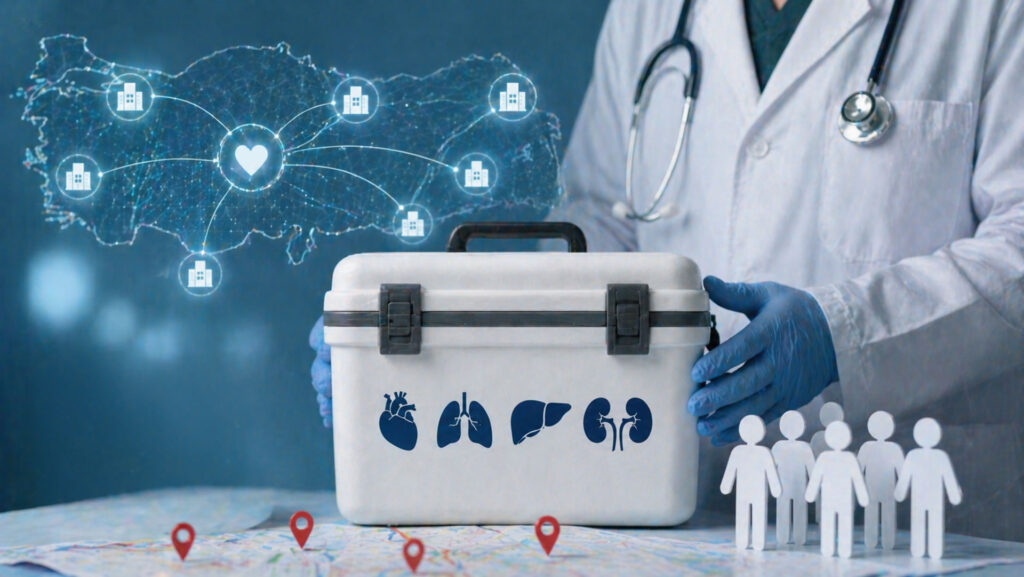
Brain Death and Organ Donation, Organ Distribution Services and Principles, National Coordination Center, and Regional Coordination Centers
Brain Death and Organ Donation (Revised Title: Organ Transplantation Regulation, Official Gazette-26/9/2025-33029)
ARTICLE 8– (1) Brain death is decided unanimously by two physicians, one of whom is a specialist in neurology or neurosurgery, and the other an anesthesiology and reanimation specialist or intensive care specialist, in accordance with the criteria in Annex-1, the criteria in the Implementation Guide of the National Organ Transplantation and Donation Coordination System, and evidence-based medical rules. (2) It is not mandatory for the physicians mentioned in the first paragraph to be part of the same hospital staff. (3) Cases diagnosed with brain death are recorded in the software system by the organ and tissue transplant coordinator at the hospital where the case is located and reported to the Regional Coordination Center. (4) In the event that there is no organ and tissue transplant coordinator at the relevant hospital, the notification is made by the chief physician’s office to the Regional Coordination Center. In this case, the Regional Coordination Center is responsible for the relevant notification and recording procedures. (7) (Addition: OG-26/9/2025-33029) Procedures for organ donation from deceased persons are carried out according to the procedures and principles set forth in the Law. The Ministry keeps records of donation declarations made electronically and stores them in accordance with the Personal Data Protection Law No. 6698 dated 24/3/2016. The following rules apply to procedures regarding organ donation carried out in electronic environments: a) Procedures regarding organ donation to be made by individuals electronically are carried out via the organ donation application on the e-Government Gateway or the e-Nabız (e-Pulse) System. b) In the method of logging into the individuals’ e-Nabız profile, logging in via the e-Government Gateway or secure electronic signature/mobile signature via e-Nabız is used as a secure authentication tool. c) Procedures for organ donation made electronically are completed with a two-step verification method. ç) Organ donation declarations are notified to the persons determined by the donor at the time of declaration via e-Nabız. d) The donor may change their declaration regarding organ donation subject to the procedure specified in this paragraph. (8) (Addition: OG-26/9/2025-33029) A person may determine or rank their spouse, adult children, mother or father, or one of their siblings—or if these are not present, any relative—to express their will regarding organ donation after death. In the event that the will of the determined person is contrary to that of the deceased’s other relatives, the will of the determined person shall prevail. (9) (Addition: OG-26/9/2025-33029) In cases where the person has no declaration regarding organ donation, organs or tissues are retrieved from the deceased with the consent of the spouse present at the time of death, adult children, mother or father, or one of the siblings, respectively; if none are present, with the consent of any relative present. (10) (Addition: OG-26/9/2025-33029)Spouses and first-degree relatives of donors whose organs have been transplanted to others are given priority—after urgent patients—should they need an organ transplant.
What is the Difference Between Brain Death and Vegetative State?
The concepts of brain death and vegetative state are different. The most important difference is that patients in a vegetative state continue to breathe on their own. These patients continue to live for months or years and, in some cases, can even recover and return to their normal lives.
What is Organ Donation?
It is a person’s permission, while alive and of their own free will, for their tissues and organs to be used for the treatment of other patients after their medical life has ended. According to Law No. 2238, everyone over the age of 18 (eighteen) who is of sound mind can donate all or part of their organs.
Where Can Organ Donation Be Made?
- Via e-Government (e-Devlet)
- To Health Directorates
- To Hospitals
- To Police Directorates (During Driver’s License acquisition)
- To Centers performing Organ Transplantation
- To foundations, associations, and similar organizations dealing with organ transplantation.
Is Organ Donation Permissible from a Religious Perspective?
Organ donation has no religious drawbacks. The High Board of Religious Affairs of the Presidency of Religious Affairs declared organ transplantation permissible with its decision dated 6.3.1980 and numbered 396/13. The Quran states: “Whoever saves a life, it is as if he had saved the lives of all mankind.” (Surah Al-Ma’idah, Verse 32)
To Whom are Donated Organs Transplanted?
Patients to receive organs are primarily determined according to:
- Blood type and tissue type compatibility,
- Criteria such as age, height, and weight,
- Medical urgency status.
Cadaveric Donor: If the organs of patients who develop irreversible brain damage (brain death) while continuing treatment in intensive care are donated, they are defined as cadaveric donors. Living Donor:A person who donates one or part of their healthy organs to another person in need, provided that it does not impair their own health and quality of life. LIVING DONOR TRANSPLANTATION can be made from relatives of the recipient up to the fourth degree (including the 4th degree). Non-relative transplants are performed following the evaluation of the Local Ethics Committee at the Organ Transplant Center.
Share